








Empower your potential with Skill Training Programs—transforming knowledge into mastery through practical, spiritually inspired, and industry-relevant courses designed to elevate careers, leadership, and purpose.


You must pursue lifelong skill training programs to stay ahead as industries shift; rapid technological change creates a real risk of obsolescence for stagnant professionals, while consistent learning delivers a sustained competitive advantage and tangible career resilience. By updating your technical, interpersonal, and strategic abilities, you safeguard employability, increase influence, and enable continuous innovation across roles and markets.
The World Economic Forum projects that by 202,5, roughly 50% of all employees will need reskilling as automation and AI change task mixes, so you can’t treat training as a one-time event. Data shows employers who invest in learning see better retention — 94% of workers said they would stay longer if their employer invested in their development — and that means your personal investment in ongoing training increases both short-term stability and long-term mobility.
Look at corporate commitments for proof: Amazon pledged approximately $700 million to train 100,000 employees by 2025, and similar programs at scale convert into measurable internal mobility and role transitions. When you map training to industry trends and build a scheduled plan (for example, targeted 6–12 week courses on cloud or data skills), you convert abstract learning into concrete career options.
Technology-driven role shifts are already reshaping job descriptions: the WEF forecasted around 85 million jobs displaced in some sectors by 2025, but also projected 97 million new roles will emerge, so your ability to pivot matters more than ever. You should prioritize skills that cross boundaries — data literacy, cloud platforms, basic ML understanding, and cybersecurity basics — because employers increasingly list hybrid skill sets in postings rather than narrow, single-discipline requirements.
Practical adaptation means choosing learning formats that match turnover speed: micro-credentials and 6–12 week applied courses let you add competencies rapidly, while certifications (e.g., cloud provider certs) signal verifiable capability to hiring managers. Allocate 3–5 hours per week to hands-on projects and real-world case studies, and you’ll be positioned to move into adjacent roles as tools and processes shift.
Building resilience is about diversification: when you cultivate a mix of technical skills, domain knowledge, and interpersonal strength, you reduce exposure to any single disruption. In practice, that means pairing a core expertise (for instance, software engineering) with complementary skills (product thinking, data analysis, stakeholder management) so you can compete for both specialist and cross-functional roles; that flexibility is what hires and promotions reward during volatility.
Adopt a portfolio approach: maintain at least one market-facing technical skill, one strategic capability, and one relationship-building habit (networking, mentoring). Track progress with milestones — certification, a completed portfolio project, or an internal rotation — to make your resilience measurable and visible to recruiters and leaders.
To operationalize resilience, set an annual target of learning hours (aim for about 120 hours per year, roughly 2–3 hours weekly) and a trio of goals: one certification, one applied project, and one cross-team assignment; this combination lets you demonstrate immediate impact while continuously replenishing your skillset against future disruption.

You gain broader capabilities fast when you pursue targeted training: technical tracks like cloud engineering or data science, plus complementary soft skills such as stakeholder communication, let you take on cross-functional projects that used to be out of reach. With about 50% of jobs projected to need significant reskilling by 2025 (World Economic Forum), investing in structured learning preserves your mobility and prevents skill obsolescence that can otherwise force career pivots under pressure.
Practical examples show what this looks like in action: large-scale initiatives—like AT&T’s $1 billion reskilling program and Amazon’s $700 million pledge to upskill 100,000 employees—underscore how continuous learning enables internal moves and higher-value assignments. When you treat training as a deliberate career strategy, you increase your bargaining power for promotions and assignments that accelerate pay growth and professional autonomy.
You deliver measurable performance gains after targeted training: improved time-to-competence, fewer process errors, and faster product cycles all follow when employees learn modern tools and workflows. For example, teams that adopt regular skills refreshes and hands-on labs report markedly faster delivery and smoother cross-team handoffs, enabling you to hit quarterly targets with less firefighting.
Organizations that invest in learning also retain talent longer and cut hiring costs, which affects your daily workload and team stability—94% of employees say they would stay longer at a company that invested in their development (LinkedIn). When you participate in well-designed programs, you not only become more productive yourself but also lift team KPIs and reduce the churn that disrupts project continuity.
To maximize impact, you should link training to clear performance metrics: track onboarding time, defect rates, cycle time, and customer satisfaction before and after courses, run coached practice sessions or simulations, and require 30–90 day application projects so skills transfer into measurable outcomes. These steps let you demonstrate ROI quickly and cement the performance improvements that keep your role indispensable.
You should combine short, targeted formats like microlearning (5–10 minute modules) with deeper commitments such as bootcamps (8–12 weeks) and structured mentorship programs to cover both immediate and strategic skill needs. Many organizations pair accredited certifications (for example, PMP requires 35 contact hours before you sit for the exam) with on-the-job rotations so you convert credentialing into demonstrable results and avoid outdated skills or even compliance violations in regulated roles.
Mixing formats also helps you manage time and budget: short online bursts solve just-in-time gaps, cohort-based workshops build teamwork and applied outcomes, and long-term coaching drives behavioral change over 6–12 months. Use the following breakdown to match program types to outcomes and examples.
| Microlearning | 5–10 minute modules, ideal for just-in-time skill updates; scales across teams and reduces time away from work. Example: short security refreshers delivered weekly to reduce phishing click rates. |
| Mentorship & Coaching | 1:1 or small-group pairing over 3–12 months; accelerates leadership development and tacit knowledge transfer. Example: engineering mentors increasing promotion rates by shortening time-to-productivity. |
| Workshops / Bootcamps | Intensive 1–12 week cohorts with hands-on projects; effective for rapid reskilling (e.g., data-science bootcamps that move analysts to ML-ready in 8–12 weeks). |
| eLearning / MOOCs | Asynchronous courses and MOOCs that reach tens of thousands; cost-effective for foundational knowledge and global consistency, often paired with assessments for mastery. |
| On-the-job Training / Job Rotation | Rotations and stretch assignments that embed learning in real work; proven to improve retention and cross-functional capability when structured with clear KPIs. |

You will gain scale and convenience with online learning: MOOCs and proprietary platforms let you access courses from leading universities or vendors and complete modules on your schedule; many organizations deploy blended programs so you do foundational work online and reserve live sessions for application. Tens of thousands can enroll in a single MOOC cohort, which lowers per-learner cost and gives you exposure to diverse perspectives.
You still benefit from in-person formats when you need high-fidelity practice: labs, role-plays, and cohort dynamics accelerate complex skills like negotiation or hardware troubleshooting. Bootcamps and 1–5 day workshops deliver measurable outcomes—project deliverables you can put on your CV—and they often produce faster behavior change when combined with follow-up coaching.
When you pursue certifications such as PMP, CISSP, or vendor certs like AWS, expect clear eligibility rules and exam benchmarks; PMP requires 35 contact hours, CISSP typically requires five years of paid experience for full certification, and many vendor certs include proctored exams. Employers use these credentials as filters in hiring and promotion; stacking a certification with demonstrable projects reduces ambiguity about your capability.
Workshops complement certifications by providing applied, time-boxed practice: 1–5 day sessions, cohort sizes of 10–30, and deliverables such as prototypes or sprint reports. Companies deploy design sprints or security tabletop exercises to surface real-world gaps quickly and then tie workshop outcomes to measurable KPIs like reduced defect rates or faster incident response times.
Layering a certification with a follow-up workshop and a 3–6 month mentorship plan increases retention and transfer of learning; this blended path often shortens the time to promotion because you not only hold the credential but also show applied outcomes. Recognizing how you combine accredited certifications, short microlearning bursts, and hands-on workshops will determine how quickly your new skills translate into higher responsibility and compensation.
Start by aligning program outcomes with your short- and long-term career milestones: map specific skills to roles (e.g., machine-learning models for a data scientist role, product roadmaps for senior PM) and prioritize programs that publish measurable outcomes like completion rates, employer partnerships, and median salary uplift. Look at format and timeline next — cohort-based, instructor-led courses often deliver stronger accountability and networking, while self-paced modules suit busy schedules; if you need promotion within 12 months, target programs with 3–6 month timelines and a capstone project you can add to your portfolio.
Examine return on investment quantitatively: compare cost, expected time-to-proficiency, and documented job-placement or pay-rise percentages when available. For example, programs that report a 30–50% median salary increase or advertise employer-verified capstones indicate higher ROI; conversely, avoid offerings that lack transparent outcomes or list only generic completion certificates, since outdated curricula and unverifiable claims are dangerous to your time and reputation.
Define exactly what you want to achieve within a set timeframe: specify target roles, the competencies hiring managers list in job ads, and the portfolio pieces you need to prove competency. If your goal is to pivot into frontend development, for instance, you should prioritize programs that require at least two full-stack projects, a GitHub portfolio, and interview prep — otherwise you’ll miss the practical evidence employers expect.
Be realistic about your available weekly hours and learning style; intensive bootcamps that demand 20–40 hours per week will outpace part-time courses if you can commit, but self-paced micro-credentials might be better if you juggle full-time work. Also, calculate opportunity cost: estimate how many months to proficiency and the minimum salary uplift you need to justify tuition — using that framework helps you select programs with a sensible payback period rather than chasing prestige alone.
Verify instructor and advisory-board credentials: preference should go to programs where >50% of instructors have recent industry experience (senior practitioners or hiring managers) and where syllabi are updated within the last 12 months to reflect current tools and workflows. Check for authentic hands-on components — at least one industry-aligned capstone, real datasets or client projects, and a mentor review process — because employers increasingly hire based on demonstrated project work rather than certificates.
Scrutinize outcome transparency: demand published metrics such as completion-to-employment rates, average time-to-hire, employer partners, and alumni case studies you can contact. Smaller cohort sizes and a mentor-to-learner ratio of roughly 1:10 or better materially increase feedback quality; additionally, prefer programs that offer interview prep, resume review, and direct introductions to hiring partners. Programs that offer vague guarantees or refuse to share outcome data are a red flag.
Ask specific questions before enrolling: request a sample syllabus, three recent graduate outcomes (roles and companies), retention and refund policies, and the technology stack used in projects. Also, to verify accreditation or third-party verification where applicable, and confirm whether certificates are verifiable and stackable into larger credentials — these concrete checks reduce risk and ensure the program advances your career rather than just your transcript.
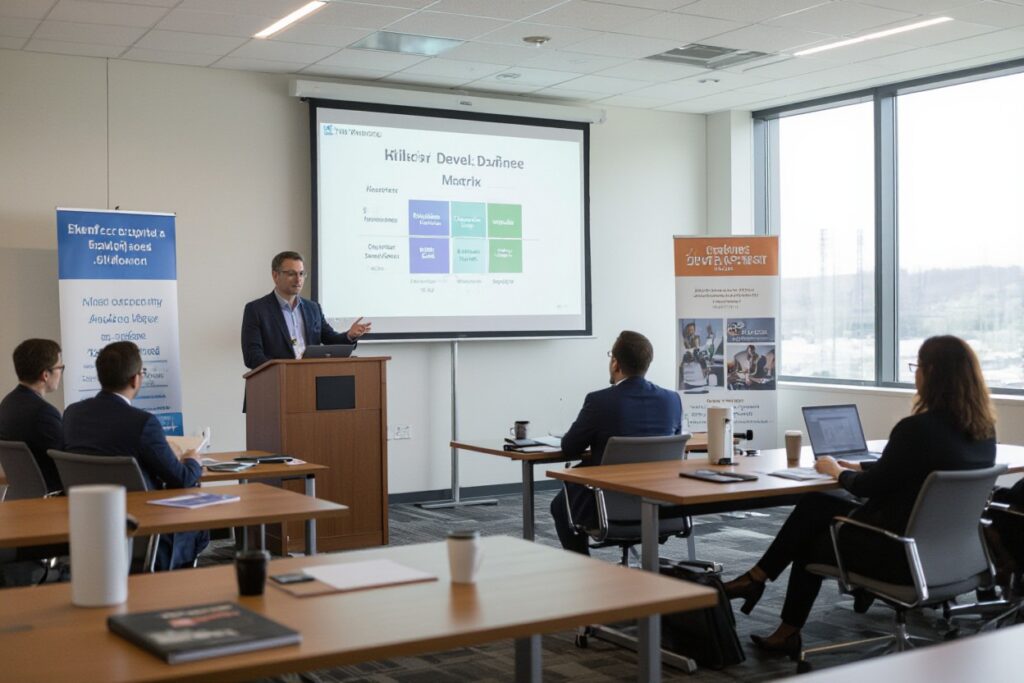
Time, cost, and competing priorities often stand between you and continued skill growth; global data from the World Economic Forum shows that by 2025, roughly 50% of workers will need reskilling, which makes delay a real professional risk. Concrete steps beat vague intentions: map the specific skills you need for the next 12–24 months, then assign measurable milestones (for example, complete a one-month course, build a portfolio project, and present results to your team) so progress is visible and defensible when you request employer support.
Many organizations have already turned this problem into a solution: AT&T committed about $1 billion to retraining efforts, and comparable programs at other firms show that internal learning pathways reduce external hiring costs and speed internal mobility. If you pitch learning as a business investment—with projected time-to-impact and reduced recruiting expense—you reposition training from a personal expense to a strategic investment your manager can justify.
Audit a typical week first: track where your 168 hours go, then identify 3–5 low-value activities to repurpose for learning. Use time-blocking and the Pomodoro method (25/5 cycles) for focused study, and lean on microlearning—10–15 minute modules during breaks or commutes—to accumulate momentum without disrupting workflows.
Schedule learning as a non-negotiable appointment on your calendar and protect it like a client meeting; doing just 2 hours per week (about 100 hours/year) produces noticeable competence gains in many technical and business skills. For deeper work, align sessions with your ultradian rhythm—90–120 minute focused blocks—so you pair quantity with high-quality concentration and faster skill transfer to on-the-job tasks.
Training cost varies widely, but you can tap multiple funding routes to lower your outlay. Many employers offer tuition assistance commonly in the range of $1,000–$5,250 per year, and in the United States, up to $5,250 can be provided tax-free under IRS Section 127. Public programs also exist in several countries—Singapore’s SkillsFuture credits and France’s Compte Personnel de Formation are examples—so check national or regional schemes before paying out of pocket.
When employer funding is limited, combine lower-cost options: MOOCs, vendor-sponsored certifications, and community college courses often deliver targeted content for a fraction of bootcamp prices (bootcamps typically range from about $7,000 to $15,000). You can also negotiate cost-sharing, ask for paid time to study, or propose cohort-based training that spreads cost across a team, reducing per-person expense while increasing organizational buy-in.
Calculate ROI to make a persuasive case: if a course costs $2,000 and leads to a 10% salary uplift on a $70,000 base, you would recoup the investment in under three months ($7,000 annual increase equals ~$583/month). Use that math in conversations with your manager—present a one-page plan showing cost, expected outcomes, timeline to impact, and how the skill reduces specific team risks or external hiring needs to improve the chance of approval.
One mid-career product manager completed a 9-month part-time data science program, built a three-project portfolio, and within 6 months moved into a senior data role with a 35% salary increase; the first production model she shipped boosted conversion by 12%. You can mirror that outcome by prioritizing hands-on projects tied to measurable business KPIs and documenting impact—hiring managers respond to concrete results, not just certificates.
When teams invest in structured upskilling, the returns are quantifiable: an anonymized mid-sized tech firm that spent about $2,500 per employee on targeted training filled 42% of open roles internally, cut external hiring costs by 28%, and saw voluntary attrition fall by 18% in one year. If you delay acting, note the broader market shift—World Economic Forum estimates that by 2025, roughly 50% of workers will need reskilling—so neglecting training can leave you exposed to skill obsolescence and lost opportunity.
When you make ongoing learning a deliberate part of your career strategy, you build resilience, leadership potential, and the ability to innovate under pressure. Your commitment to structured development delivers tangible returns—shortening problem-solving cycles, strengthening professional networks, and positioning you to shape future opportunities rather than simply react to them.
A: Lifelong skill training programs are structured, ongoing learning pathways designed for professionals to update and expand competencies across a career. They emphasize modular, just-in-time learning—micro-courses, certifications, workshops, mentoring, and project-based practice—that align with changing industry needs. These programs support the idea by enabling continuous adaptation to new tools, methods, and market demands so professionals maintain relevance and advance responsibilities over time.
A: Rapid technology adoption, shifting business models, and evolving regulatory or customer expectations create skill obsolescence risks. Continuous upskilling raises productivity, enables quicker adoption of new processes, and opens opportunities for lateral moves or leadership roles. It also reduces career vulnerability by keeping qualifications current relative to peers and marketplace requirements.
A: Traditional degrees often deliver foundational theory over a fixed timeline, while lifelong programs prioritize flexibility, relevance, and shorter learning cycles. Lifelong training focuses on skill refreshers, practical application, continuous assessments, and industry-aligned credentials that can be stacked. Delivery modes are diverse—online modules, cohort-based bootcamps, on-the-job learning—so learners can upskill without interrupting work.
A: Measurable outcomes include improved performance metrics (faster project completion, higher quality scores), higher promotion and salary rates, expanded job mobility, and greater recognition for specialized skills. Organizations often track certification attainment, reduced time-to-competency for new roles, retention rates, and internal hire ratios as concrete indicators of program impact.
A: Start by mapping short- and long-term career goals, then evaluate programs for alignment with those goals, credential recognition, instructor expertise, hands-on practice opportunities, and update frequency of content. Assess delivery format (self-paced vs cohort), time and cost commitments, employer support or tuition reimbursement, and measurable outcomes such as industry-recognized certificates or demonstrable portfolios.
A: Use microlearning to consume content in 10–30 minute blocks, schedule protected learning time weekly, apply learning immediately through small projects, adopt blended learning (mix live sessions with asynchronous study), and leverage employer-sponsored training during work hours. Set specific learning goals, track progress with short milestones, and use peer learning or mentorship to accelerate application and retention.
A: Employers should create a learning culture by funding programs, providing time for training, building clear career pathways linked to skill milestones, and offering mentoring or stretch assignments. Benefits include higher employee engagement, faster internal mobility, reduced recruitment costs, and enhanced innovation as teams acquire up-to-date capabilities. Strategic partnerships with training providers and measuring ROI through performance and retention metrics ensure alignment with business goals.